SIDO 2015 Milano
2019-11-13T08:14:42+00:00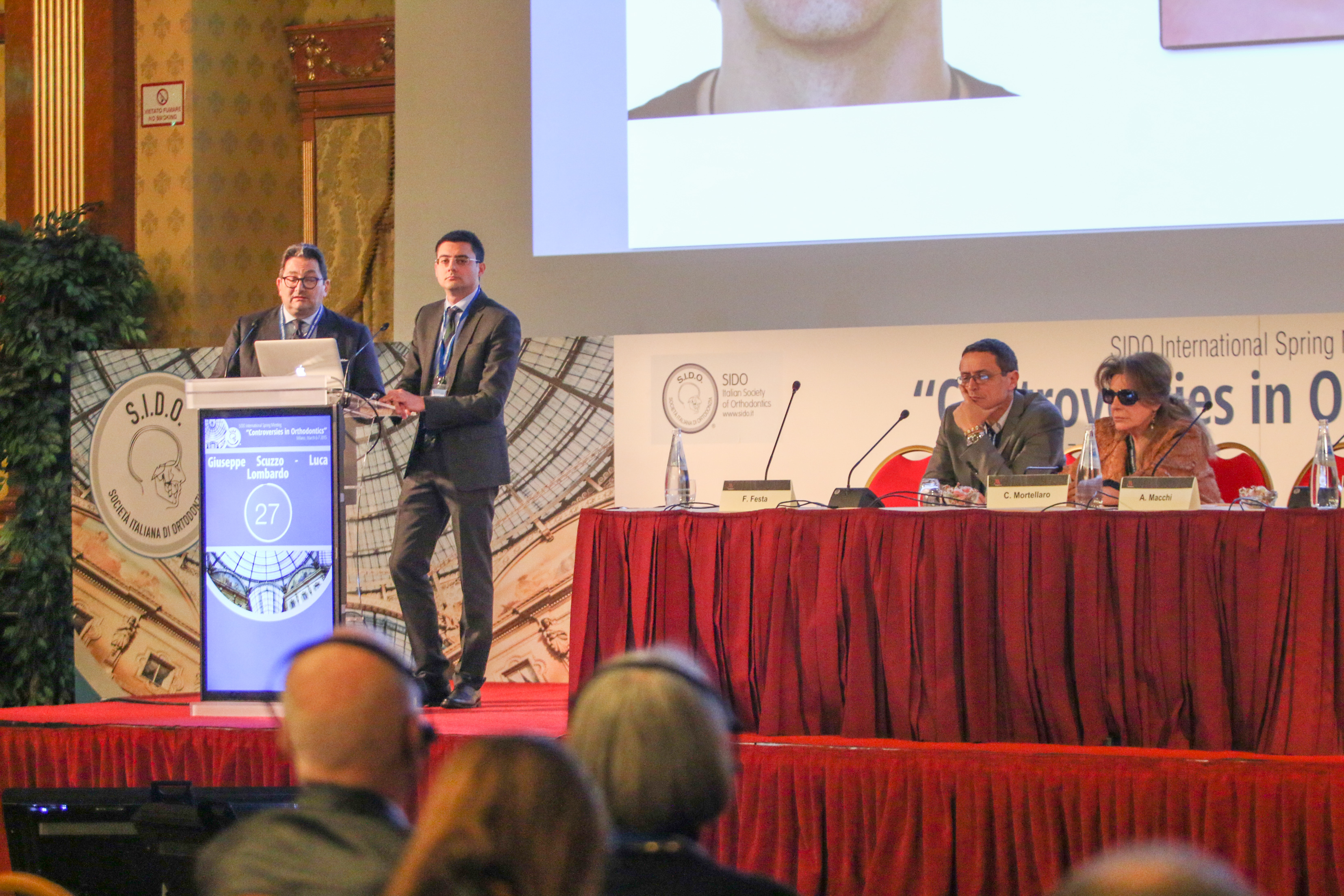

Abstract
Background: The aim of this study is to calculate and compare the play and torque expression of 0.018 and 0.022 bracket slots when engaged with archwires of different size, cross section and material.
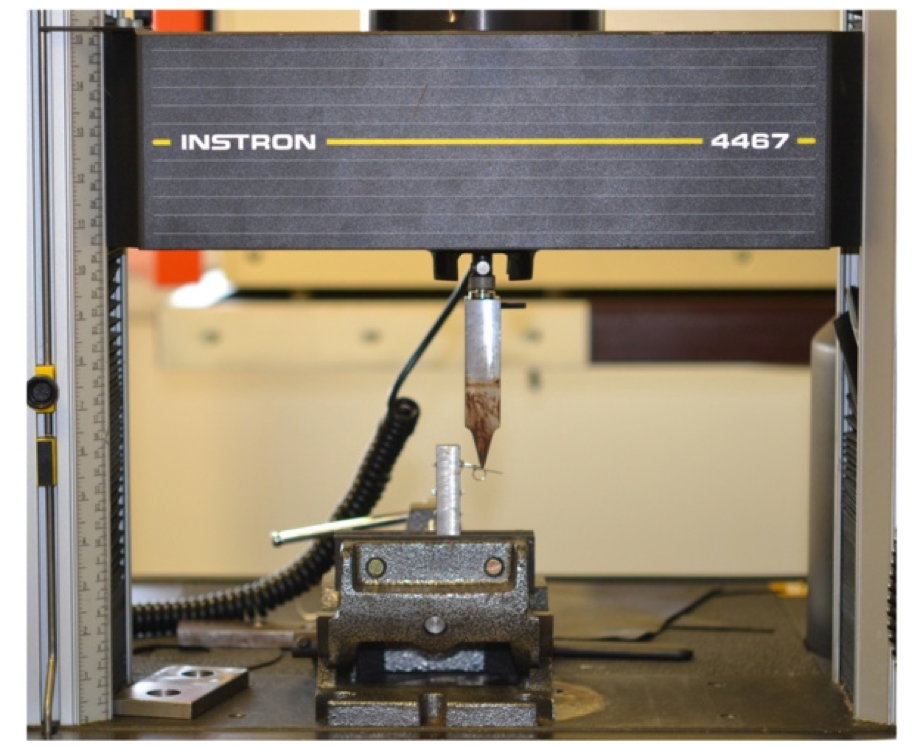
Methods: Eight orthodontic brackets, two of slot height 0.018 and six of slot height 0.022, from different manufacturers, were measured and fixed to a vertical support. Twenty-four archwires of differing size, cross section and material were selected, measured and tested in each bracket of compatible slot width. Compression testing by Instron dynamometer and geometric calculations enabled us to determine the play angle of each bracket/archwire combination, and the angle at which a clinically efficacious force couple, sufficient for dental movement, is exerted.
Results: All bracket/archwire combinations considered were found to have play angles far above the ideal. This is ascribable to the slots being oversized with respect to the manufacturers’ claims. Likewise, some archwires were found to be oversized, while others undersized.
When the same archwire was tested with brackets from different manufacturers, the play and torque expression differed, despite the same nominal dimensions of the slots. When the same bracket was tested with the same size archwires, their construction material was found to influence the torque expression, due to the difference in elastic modulus, but not the wire/slot play.
Conclusions: The dimensional precision of orthodontic brackets and archwires and the rigidity of the latter have a profound influence on the torque expression of pre-angled appliances.
Keywords: Torque expression; Slot precision; Play



Luca Lombardo; Giorgia Toni; Filippo Stefanoni; Francesco Mollica; Maria Paola Guarneri; Giuseppe Siciliani
Angle Orthod. 2013;83:298–305.
ABSTRACT
Objectives: To investigate and compare the characteristics of commonly used types of traditional and heat-activated initial archwires at different temperatures by plotting their load/deflection graphs and quantifying three parameters describing the discharge plateau phase.
Materials and Methods: Forty-eight archwires of cross-sectional diameters ranging from 0.010 inches to 0.016 inches were obtained from seven different manufacturers. A modified three-point wire-bending test was performed on three analogous samples of each type of archwire at 55uC and 5uC, simulating an inserted archwire that is subjected to cold or hot drinks during a meal. For each resulting load/deflection curve the plateau section was isolated and the mean value of each parameter for each type of wire was obtained.
Results: Permanent strain was exhibited by all wires tested at 55uC. Statistically significant differences were found between almost all wires for the three considered parameters when tested at 55uC and 5uC. Loads were greater at 55uC than at 5uC. Differences were also found between traditional and heat-activated archwires, the latter of which generated longer plateaus at 55uC, shorter plateaus at 5uC, and lighter mean forces at both temperatures. The increase in average force seen with increasing diameter tended to be rather stable at both temperatures. Conclusions: All nickel-titanium wires tested showed a significant change related to temperature in terms of behavior and force for both traditional and heat-activated wires. Stress under high temperatures can induce permanent strain, whereas the residual strain detected at low temperatures can be recovered from as temperature increases. (Angle Orthod. 2013;83:298–305.)
KEY WORDS: NiTi archwire; Load deflection characteristics; Mechanical behavior
Luca Lombardo, Yildiz Öztürk Ortan, Özge Gorgun, Chiara Panza, Giuseppe Scuzzo and Giuseppe Siciliani
Progress in Orthodontics 2013, 14:28
Abstract
Background: This study compared the oral hygiene and caries risk of patients treated with labial and lingual orthodontic appliances throughout a prospective evaluation of the status of the oral environment before and after bracket placement.
Methods: A total of 20 orthodontic patients aged 19 to 23 years were included in the study and were divided into two groups: 10 patients wore Roth labial appliance (American Orthodontics, Sheboygan, WI, USA) and 10 patients wore STb lingual appliance (Ormco Corporation, Glendora, CA, USA). Plaque index (PI), gingival bleeding index (GBI), salivary flow rate, saliva buffer capacity, salivary pH, and Streptococcus mutans and Lactobacillus counts in saliva were determined at three time points: before orthodontic appliance placement (T0), 4 weeks after bonding (T1), and 8 weeks after bonding (T2). After appliance placement, all patients were periodically educated to the oral hygiene procedures. Wilcoxon rank and Mann-Whitney U tests were used to determine intragroup and intergroup differences as regards qualitative data. To compare quantitative data between the groups, chi-square and Fisher’s exact tests were undertaken, while intragroup differences were tested with McNemar test. The level of statistical significance was set at p < 0.05.
Results: Statistical analysis of the data obtained revealed a statistically significant difference between the data of T0 and T1 and the data of T0 and T2 of the PI scores and between T0 and T2 of the GBI scores in the group treated with the lingual appliance. The GBI value increased significantly between T0 and T1 but decreased significantly between T1 and T2 (p < 0.01) in the group treated with labial appliance. S. mutans counts increased significantly between T0 and T2 in the saliva samples of patients treated with lingual appliance. No statistically significant differences were found between S. mutans and Lactobacillus counts at the three terms of saliva collection in patients treated with labial appliance. No statistically significant differences were found between the two groups at the three time points as regards the salivary flow rate and saliva buffer capacity.
Conclusions: Lingual and labial orthodontic appliances showed a different potential in modifying the investigated clinical parameters: patients wearing STb lingual orthodontic appliance had more plaque retention 4 and 8 weeks after bonding, while there were more gingival inflammation and more S. mutans counts 8 weeks after bonding. No differences were found between the two groups as regards the Lactobacillus counts, the salivary flow rate, and saliva buffer capacity.
Keywords: Oral hygiene habits; Orthodontic treatment; Salivary test; Lingual appliance; Labial appliance